Monday, March 11, 2013

Oh, lord, these critters are cute. I like to call them the death-of-focus crab and the attention-deficit fish. Hours spent staring at these new tank additions, countless reminders "Ok, move away from the tank and get back to work". Every time we get quietly settled into our routine...

"Look! The Sun Cat fish are in the castle with the Plecostomos!"
 "Look, the crab is on top of the tree!"
"Look, the snail has moved!"

And that's just me and Erin.

Yeah, we're all pretty in love with our new tank additions: one cranky fiddler crab, an algae-sucking, prehistoric looking plecostomos, a mystery snail, a bunch of guppies, and a few other little fishies.
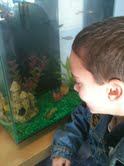
Plecostomos is keeping a watchful eye on Bo.

King of the castle

Crab telling plecostomos, "Get offa my lawn!!"


If you haven't read the "Bad Kitty" books by Nick Bruel, you are missing out. Absolutely hilarious. We have been reading "Bad Kitty Gets a Bath" for read aloud.


 Just to give you a taste of how much Bad Kitty loathe baths...
Here are some items you might need for Kitty's bath:


Here is a persuasive letter the class wrote to Bad Kitty's owner:


Dear Owner,

My name is Bad Kitty and I don’t want to take a bath!

I don’t want to take a bath because Bad Kitty+water=EXPLOSION!

Also, I could drown in it. And because I am already clean. Also, I don’t like getting brushed.

I do not like getting wet!

I don’t want the soap or shampoo to get in my eyes.

Please, do not give me a bath!

Sincerely,

Bad Kitty 

Then, we wrote one back to BK:

Dear Bad Kitty,
I am your owner and I want to give you a bath. If you don't get a bath, you will get sick and you will not like that. Also, you will develop a hairball. Plus, you smell really bad!
Do you think that a bath is revolting? 
Please let me find you in the tub!
Sincerely,
Your owner

It's a darn good thing we learned how to write persuasive letters this week because we really had to put them to work. You see, Julie Siler came in on Tuesday to let us know that she was ready to contribute our spy mission money to the National Wildlife Association to help out the Canadian Lynx. With the $20 we earned, we would get a certificate and a letter of thanks. Wait, what? Last year we got a stuffed animal when we contributed to help the Mekong Dolphin. Why no stuffed Lynx? Well, Julie told us, the stuffed animals are only with a $30 contribution. But maybe, just maybe, we could convince the ever elusive Agent O to cough up some more cash...but we'd have to have a really good argument. 
 

Just look at these impassioned pleas for more money!

'
"Dear Agent O,  I am writing to ask for 10 dolrs. You should give us the money because it wel hep the animal more. Also, you should give us the money because we wel hav a toy lynx. Just think about the por lynx."

"Dear Agent O, I am writing to ask for 10 dollars. You should give us the money because the Lynx could die! Just think about if you wur an annamul this was dieing."

"Dear Agent O, I am writing to ask for $10 to help a Lynx. You should give us the money because with it we can help a lynx. Also, you should give us the money because we can get the stuffed animal. Just think about people trap it for fur."

Dear Agent O, I am writing to ask you if you can give us $10.00 dollars for the stuffed lynx. You should give us the money because we can cuddle with the stuffed lynx. Also, you should give us the money because we can help the animal more. Just think about the living animal."

We also read a great book and watched a video on the powers of persuasion:
http://www.youtube.com/watch?v=nMayGIVmfgA

We can tell it's already working, this persuasion thing...by the end of the day on Friday, the students had already built quite a case for getting more money for a stuffed animal, but for getting more fish and crabs, as well. One student was even vying for an eel.
 I think we've created a monster.


Sunday, March 3, 2013


I come from a family of huggers, kissers, and pull-into-your-lappers. Earlier this week my 69 year old father, who is scheduled for hernia surgery in two weeks,  attempted to lift my almost 5 foot tall, ten year old son into his arms. I say attempted, because my watchful, no nonsense Mother, who was in no mood to end up in the emergency room with the old man, quickly put stop to it. The same way she put a stop to it many years ago when he was still trying to hug and kiss me and my teenage brother in front of our totally cool, punk rock friends. Oh, the humiliation.

I get it of course, especially since my own two children are very, very affectionate little buggers. But in my big, demonstrative, Jewish family it's not just parents and children showing the love, but brothers, sisters, aunts, and uncles greet with full on, frontal hugs and kisses each time we see each other...often resulting in a "Crusher" (Aunt S.), "Mismatched Heights"(Uncle R.) or ""The Way-To-Long" hug (Uncle B). The awkward "Man Hug"? No, not in my family. The men hug just as tight and kiss-y as the rest. As a result, I grew up thinking everyone's family was overly affectionate. I think my jaw hit the floor with an audible clank the first time I saw my (then boyfriend) now husband, greet his Father with a hand shake! And oh, my, did he just give his brother a side hug?? How charmingly puritanical!

And that's just fine. Some of us are huggers, some of us are not.

So, to hug or not to hug at school?  In some schools it's frowned upon to so much as put an arm around a child. Here at Hirsch, we love our hugs. And boy, do we have some little love bugs in our class! For some, it's really regulating to have a lap to sit in while listening to a book, whether its a need for proprioceptive input, or just a need to feel loved and secure, we've always been open to warm displays of affection. We've long had a rule for the "upstairs kids" that when they greet each other we expect that they high five or fist bump,  not hug. Of course, there are a million exceptions to this rule. Some gives you a gift? A hug is ok. Haven't seen your best buddy at all over the summer break? A hug is totally warranted. Your friend is really, really sad because his pet died? A hug can do wonders. For the most part, though, we've told them if they need a hug, they can always come to us. And they still can, but the definition of a hug has changed a little bit. Why? As we told the kids this week, our little love bugs are no longer so little. Suddenly, we have some really big 8, 9, and almost 10 year olds! Heidi and Gudny's class has 11 and 12 year olds! We want school to be a loving and nurturing environment, but at the same time, we feel like we have a responsibility to the students to teach them age appropriate boundaries. There are different expectations for children as they grow up. So, here's the change:
1. The teachers are still available for hugs, but they must be side hugs. Full on hugs should be reserved for Mom and Dad. If they want to sit next to us and lean during an activity, they are still welcome to do so, but such big kids don't need to sit on teachers' laps.

2. High five-ing, fist bumping, secret hand shaking adults & kids

I think this is actually more heartbreaking for us, the teachers, than for the students. *sniff* when did they get so big???

You know who don't need  hugs? The Norse Gods. They are way to busy bravely protecting the world(s) from the forces of evil for silly tokens of human affection. Here's an awesome Diamante poem the class wrote this week honoring theses tough guys and gals:

Gods
mighty greedy
ruling partying flying
Sif Odin Loki Thor
fighting dying living
magical brave
Aesir

There are just a few rules to writing a diamante:
  1. Diamantes are seven lines long.
  2. The first and last lines have just one word.
    The second and sixth lines have two words.
    The third and fifth lines have three words.
    And the fourth line has four words.
  3. Lines 1, 4, and 7 have nouns.
    Lines 2 and 6 have adjectives.
    Lines 3 and 5 have verbs.
Here’s an easy way to visualize all three rules:
Noun
Adjective, Adjective
Verb, Verb, Verb
Noun, Noun, Noun, Noun
Verb, Verb, Verb
Adjective, Adjective
Noun

Next week we will write more Norse poetry, in honor of  Bragi, the god of poetry.
Bragi!

 In Fairy Tales there are 3 Little Pigs desperately in need of some hugs. Or at least two of them, who have lost their homes to that nasty big, bad Wolf. Here's the version they read this week:
Making wolf and pig puppets

Making a wolf puppet

Math:

Here Tani and Annabella explore the many ways to make a number by playing "Go to the Dump". Similar to Go Fish, the players try to win as many of their opponent's cards as possible by asking for numbers that will add to their cards to make a target sum. For example, if the target sum is 10 and Tani has a 7 and a 1, he might ask Annabella for a 2.     7+1+2=10.  If she does not have a 2, she says "Go to the Dump" and Tani draws from the "dump" pile. These two clever mathematicians quickly discovered that they could also hit the target number by using subtraction as well as addition.

Tami showing one way to make 10 while playing the card game "Go to the Dump": 3+3+4


And another way: 7+7-4


Annabellas's way: 7+8-5


Saturday, February 23, 2013

http://www.nytimes.com/2010/02/02/opinion/02engel.html?_r=2&

I read this article a few years ago.  It pretty much sums up what I believe elementary education should be about. While my own elementary education was far from traditional, I opted to begin my teaching career in public school. Silly me, I totally took for granted the fact that education was to prepare students to be thinking, feeling human beings. Quickly I realized that I was so, so wrong! My first clue? The chant at school assembly the first day, sung to the tune of "Y.M.C.A.":

It's fun to ta-ake the I-T-B-S
It's fun to take the I-T-B eh-eS
Sharpen the pencil
Take a seat
Fill in the bubble
it's so so neat...

The ITBS being the Iowa Test of Basic Skills, just one of the many standardized tests we were forced to give the students. So out of the window went my thinking, feeling little sweeties, in the classroom we were teaching to the test automatons. "But wait, some of my students are non-verbal/non-readers/highly anxious/over-reactive/under-reactive to sensory stimuli/not fully potty trained/unable to self regulate/can't hold a pencil...etc..." I said to anyone who would listen, "Do they really need to memorize a bunch of facts in order to take this test? Oh, yes, I was told. They did.

I stuck around public school for much longer than I should have, thinking maybe I could change the system (silly, silly me!). The longer I work here at Hirsch and within the DIR community at large, the strong my beliefs become about what school should and should not be. And not just for our population, but for all children.

 
 Wish ALL schools would read this. THIS is why I believe students at Hirsch are being prepared for "higher learning"... more than many students in "traditional" schools today.

This sums it up for me:

  Simply put, what children need to do in elementary school is not to cram for high school or college, but to develop ways of thinking and behaving that will lead to valuable knowledge and skills later on.

You can teach anyone to take a test. You can teach anyone to fill in bubbles with a number 2 pencil. You can teach anyone to memorize the multiplication tables, increase their reading words per minute, spell every spelling pattern known to man, diagram a sentence, and write in the most beautiful darn cursive you ever did see. Not that some of these skills aren't important (well, except for diagramming sentences. Some please explain that one to me), but not one of them is as crucial for an elementary school aged child as the ability to think and the ability to get along with other people. Those other skills? They'll come. Or maybe they won't, but that's what calculators and computers are for. But without friends, a child can't truly be a child. Without really being able to think, regurgitating your multiplication tables amounts to nothing but a bunch of meaningless numbers.

Here are some choice nuggets from the article:

In this classroom, children would spend two hours each day hearing stories read aloud, reading aloud themselves, telling stories to one another and reading on their own. After all, the first step to literacy is simply being immersed, through conversation and storytelling, in a reading environment; the second is to read a lot and often. A school day where every child is given ample opportunities to read and discuss books would give teachers more time to help those students who need more instruction in order to become good readers. 

Yes! Fairy Tale/Myth Curriculum! We are a community of readers. We share a common bond, a common understanding.


Children would also spend an hour a day writing things that have actual meaning to them — stories, newspaper articles, captions for cartoons, letters to one another. People write best when they use writing to think and to communicate, rather than to get a good grade. 

Yes! Check out the notes out downstairs neighbors have left us! Read our journals! Read our daily reflections!


In our theoretical classroom, children would also spend a short period of time each day practicing computation — adding, subtracting, multiplying and dividing. Once children are proficient in those basics they would be free to turn to other activities that are equally essential for math and science: devising original experiments, observing the natural world and counting things, whether they be words, events or people. These are all activities children naturally love, if given a chance to do them in a genuine way. 

Yes!  Does your child know that 7X7=49? Great. But given a bag of 49 candies and 7 hungry, sugar- loving friends, what would they do?
 

Along the way, teachers should spend time each day having sustained conversations with small groups of children. Such conversations give children a chance to support their views with evidence, change their minds and use questions as a way to learn more. 

Snack time, lunch time, show and tell, recess.  These are moments of deep, learning opportunities. We milk them for all they are worth. "Why do you feel this way?" " Do you agree?" " Look! you have this in common!"" You disagree, what is a polite way to let him know?""He disagrees with you. Does that mean he's not your friend?" "That makes your friends have uncomfortable thoughts. Why? What can you do to change this?" 

During the school day, there should be extended time for play. Research has shown unequivocally that children learn best when they are interested in the material or activity they are learning. Play — from building contraptions to enacting stories to inventing games — can allow children to satisfy their curiosity about the things that interest them in their own way. It can also help them acquire higher-order thinking skills, like generating testable hypotheses, imagining situations from someone else’s perspective and thinking of alternate solutions.

Yes, yes, yes! By now you've probably heard a little bit about this thing called Floortime...

A classroom like this would provide lots of time for children to learn to collaborate with one another, a skill easily as important as math or reading. It takes time and guidance to learn how to get along, to listen to one another and to cooperate. These skills cannot be picked up casually at the corners of the day.

 Think about what you, as adults, do every day. Collaborate, negotiate, cooperate, listen. And these are not easy skills, not for anyone. They take practice, guidance, a loving, patient, judgement free environment.


I know, right? This article is preaching to the choir. You wouldn't be here if you didn't know that these skills are more important than any other academic or non academic skill.
Just wanted to remind all of us, including myself, that we are on the right track. We are working on some really, really good things at Hirsch. 

And here's the proof, right here in these beautiful little souls! Behold some pictures from this week:


No, I didn't make that candy division problem up. With leftover Valentine's Day goodies, I challenged the students to figure out how to divide it evenly between them. They also predicted which color would show up the most, and which the least. After dividing and sorting by color, they graphed their findings and compared. 


After reading the book "How Much is a Million?" these students were inspired to write some REALLY BIG numbers:


Scenes from yoga on Thursday:


Making "worms" in science:


Weight investigation: Which one weighs more? How much do you think the bag weighs?

Bag of gravel or...
5 pound medicine ball?


Testing the ball
Testing the bag


Weight predictions


Long term art/math projects: Making our own wall calendars based on our interests. 


We're going to begin making personal time lines in the next few weeks. Please send in some info about your child's life as soon as possible.

Suggestions:

Date, time, length, weight at birth
Major life events (ie: baby brother is born, moved to new house)
Firsts: . (ie..first step, fist word, first school, first plane ride...)
Pictures! Baby/toddler/through today. You can send them in and I will copy and return them, or you can email them to me.


Sunday, February 10, 2013

Sharon Jones and her Dap-Kings would like to remind you that Tuesday was our 100th Day of School!!!

 Let the soulful Ms. Sharon set the stage for our 100th day celebration activities:

http://www.youtube.com/watch?v=8ouI5KcyHfE


Pizza: What do you like on your pizza? Pepperoni? Mushrooms? Meatballs? You can have it all, but only up to 20 of each item. And your items must add up to 100 all together. Not one green pepper more or less...


Popcorn: Are there more than 100 pieces of popcorn in a bag? How will you count 100 pieces? One at a time? By 2s? By 5s or 10s? Will they all fit on a piece of construction paper? Answer these questions and then make a picture or sculpture with your 100 pieces and glue!


Paperclips: How long would 100 paperclips be if you made a chain. As long as your arm? As long as your body? How many times could you wrap the chain around your head/arm/body?


Pours: Using a plastic cup, you have 100 seconds to fill a gallon container with water. Can you do it? How long do you need to complete this task? More time? Less? How long would it take to fill 1/2 gallon?


Speaking of filling with water...take a gander at our beautiful new fish tank! At the beginning of the year I applied for a grant with an organization called Pets in the Classroom  http://www.petsintheclassroom.org/. This tank is a much needed improvement over our two other small tanks (with the broken filters).  We hope to add some new piscine pals for our lonely old fish soon. We're also thinking a handful of mystery snails are in order to keep the tank sparkling clean. Here are some shots of Annabella and Jennifer (from next door) working together to fill the tank. It took A LOT of pours...definitely longer than 100 seconds!


One more word from Ms. Sharon Jones:

http://www.youtube.com/watch?v=EB69Ij5X6AE

That's right, Sharon wants to you tell her you love her. But you can wait until next Thursday, February 14th. Yes, Valentine's Day is almost upon us. Here is a class list for V-Day cards for both of the upstairs classes. We've become such a tight knit group, I'm sure some of our guys will want to give cards to them, too (though it's not necessary). Just make sure that there is a card for everyone in Heidi and Gudny's class if your child decides to make exras!

Our Class:
Bo
Paul
Oliver
Annabella
Jakob
Tani
Aidan

Heidi and Gudny's:
Max
Gabriel
Jac
Jennifer
Dino
Davis
Ross