Real or genuine.
True and Accurate.
Ah, the strive for authenticity in today's culture. It's a marketing buzzword meaning "Getting back to what matters in life: the simple things". Farm to table, urban chicken coops, fiddle playing band members with beards so bushy they can hide an entire West Elm Authentic Moroccan Rug within.

We want everything to be Real. Simple (Wait, that sounds like a great name for a magazine!). I mean, we want to really get back to our roots. A time when life was about beekeeping and churning butter. When men were, well, hairy, and women were crafty. Or vice versa.
Heck, even the trendy cookware store, Williams-Sonoma has an Agrarian division. I know local farmers are elbowing their way into the Lenox Mall store to get a hold of their Butter Making Kit (including Rooster Butter Stamp)!
 |
| "Just add cream for fresh, flavorful butter in 20 minutes...A Bas-relief rooster image adds a flourish to fresh churned butter" |
 |
| How 'bout them apples??? |
If your apples ain't sorted and your butter ain't stamped, then I seriously question your commitment to authenticity.
Here at Hirsch we love to keep up with the trends. So of course I'm all about authenticity. I'm even letting my beard grow as we speak. Just kidding, I shaved this morning. I'm actually talking about AUTHENTIC ASSESSMENTS.
What is an authentic assessment? First, let's talk about Traditional Assessments. These are the multiple choice, fill-in-the-blanks, true or false tests. These can be (cue scary music) standardized tests or teacher created tests. The answer is on the page, the student just has to find it and bubble it in.

These tests are not inherently bad, though. We do some here: KeyMath and the TOWRE reading are standardized. Just this week the students watched a video and completed a fill in the blank (aka "cloze" in teacherese) activity to demonstrate comprehension. But not every student performs well on these types of tests. I'm no dummy, but if I told you my SAT scores your jaw would hit the floor. You know how you get points for filling in your name? My score (after taking 2 prep classes) was only a smidge higher than that. So while these traditional assessments are a great, quick, down and dirty way to get information on a child, they are only part of the big picture.
Thank you to Jon Mueller's blog: http://jfmueller.faculty.noctrl.edu/toolbox/whatisit.htm for giving a clear picture of how Authentic Assessment is different from Traditional Assessment:
In contrast (to Traditional Assessment), authentic assessment (AA) springs from the following reasoning and practice:
1. A school's mission is to develop productive citizens.
2. To be a productive citizen, an individual must be capable of performing meaningful tasks in the real world.
3. Therefore, schools must help students become proficient at performing the tasks they will encounter when they graduate.
4. To determine if it is successful, the school must then ask students to perform meaningful tasks that replicate real world challenges to see if students are capable of doing so.
2. To be a productive citizen, an individual must be capable of performing meaningful tasks in the real world.
3. Therefore, schools must help students become proficient at performing the tasks they will encounter when they graduate.
4. To determine if it is successful, the school must then ask students to perform meaningful tasks that replicate real world challenges to see if students are capable of doing so.
Thus, in AA, assessment drives the curriculum. That is, teachers first determine the tasks that students will perform to demonstrate their mastery, and then a curriculum is developed that will enable students to perform those tasks well, which would include the acquisition of essential knowledge and skills. This has been referred to as planning backwards (e.g., McDonald, 1992).
If I were a golf instructor and I taught the skills required to perform well, I would not assess my students' performance by giving them a multiple choice test. I would put them out on the golf course and ask them to perform. Although this is obvious with athletic skills, it is also true for academic subjects. We can teach students how to do math, do history and do science, not just know them. Then, to assess what our students had learned, we can ask students to perform tasks that "replicate the challenges" faced by those using mathematics, doing history or conducting scientific investigation.
Traditional --------------------------------------------- Authentic
Selecting a Response ------------------------------------ Performing a Task
Contrived --------------------------------------------------------------- Real-life
Recall/Recognition ------------------------------- Construction/Application
Teacher-structured ------------------------------------- Student-structured
Indirect Evidence -------------------------------------------- Direct Evidence
These 2 types of assessments are not mutually exclusive. Many of the children at Hirsch are not ready for traditional assessments, so the teachers rely solely on authentic activities to assess mastery. The students in our room are able to do both. The benefits of authentic assessment are huge. Often, while we are looking for a specific skill, we encounter so much more than we thought. We get so much information from real life and high interest tasks, that sometimes we find the students have skills far beyond what the tests show. Conversely, a student who aces a test might have difficulty demonstrating a skill in the real world.
And let's face it, in the real world no one hands you a sheet of paper and asks you to do this:

Here is an example of how we are constantly challenging, assessing, and looking for evidence of growth and mastery in our room.
PIZZA FRACTION CHALLENGE:
We've been learning about fractions for the past several weeks. Many of the students have become quite proficient at identifying parts to the whole, sorting fractions by size, and some even recognizing equivalent fractions. We use fractions throughout the day, all day, every day,without the students even realizing.
"Hey, Tani, can you hand me 1/3 of the crayons in your hand?"
"Zoe, you only need to finish 1/4 of the problems on that page."
"We are going to watch 1/2 of the Medusa movie today. How much will we watch tomorrow to finish it?"
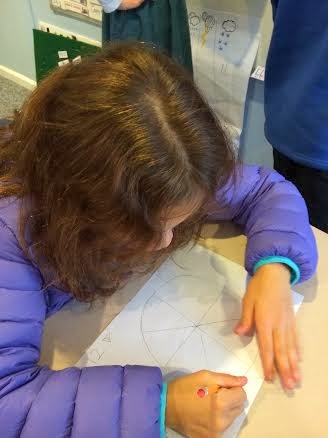
Things got real (authentically real, that is) on Wednesday when solving a serious fraction puzzler was the ticket to a delicious lunch of homemade pizza. Annabella and Zoe were our chefs, but before we cooked the pizza we asked the students to figure out how to divide it evenly. Their first task was to draw their idea on paper and then transfer their ideas to the board. We learned so much from this activity:
1. All of our students can apply their knowledge of fractions to a real life problem (yay!)
2. Some of our students have a firm grasp on equivalent fractions. A couple are still a little shaky, but can get there with teacher prompting.
3. A couple of our students are still unable to cross mid line. What does this mean? Here's a web page to explain http://www.therapystreetforkids.com/CrossingMidline.html
Shelley is also a great resource on this subject.


 |
Then something really interesting happened as we compared our ideas:
Student A has a very firm understanding of fractions. This kid can manipulate numbers far above his grade level (or, for that matter, far above my grade level). Student A also loves pizza. A lot. A whole lot. So much so, that when it came down to deciding if we should divide the pizza into 7 equal parts (one slice each) or 14 equal parts (2 slices each) he was visibly agitated when the majority of the class wanted one large slice. Student A knows (and I have witnessed) that he can eat an inhuman amount of pizza in one sitting. One slice? Are you kidding???
Student B, who also has a firm grasp on fractions, was able to explain that Student A would get the same amount of pizza either way. By six or seven, most children develop the ability to conserve number, length, and liquid volume. Conservation refers to the idea that a quantity remains the same despite changes in appearance. Nothing was added to the pizza, nothing taken away, it was just going to be cut differently. This is a concept that Student A knows on paper. Give him 2 equal sized balls of clay, flatten one, and he can tell you they are still the same size. We know this from other authentic and traditional assessments. But when his emotions were involved, he was unable to demonstrate this knowledge. Finally, Student C, who up until then we were not sure truly understood the concept of conservation, chimed in:
"Either way you slice it, you get the same amount. What if you just cut it in two on your plate?"
Aha! Problem solved!That's exactly the kind of valuable group problem solving we see every day, many times a day, using authentic assessment. You just can't get that kind of information on a standardized test.
We will use the information we learned on Pizza day to drive our curriculum. We know one child's academic knowledge can be easily hijacked by emotions (he's certainly not the only one), so more highly emotional problem solving activities are needed (our specialty :)). We know we need to do some more crossing mid-line activities, more conservation activities, continue to strengthen and build knowledge of fractions. We also know pizza is yummy.
But you didn't need an assessment to figure that out, did you?


